
Vasectomy reversal,
clearly explained.
See how the vas deferens is reconnected, and how two delicate layers help rebuild the pathway for sperm.
Please try again, or open the video directly.
Open videoThe repair, step by step
Preparing the joinChoose a step to play from that point. The animation continues through the remaining steps.
The two healthy ends
The vas deferens is the tube that carries sperm. This enlarged view shows the healthy ends that will be joined.
See what changes.
The same view before connection and after the intended repair.
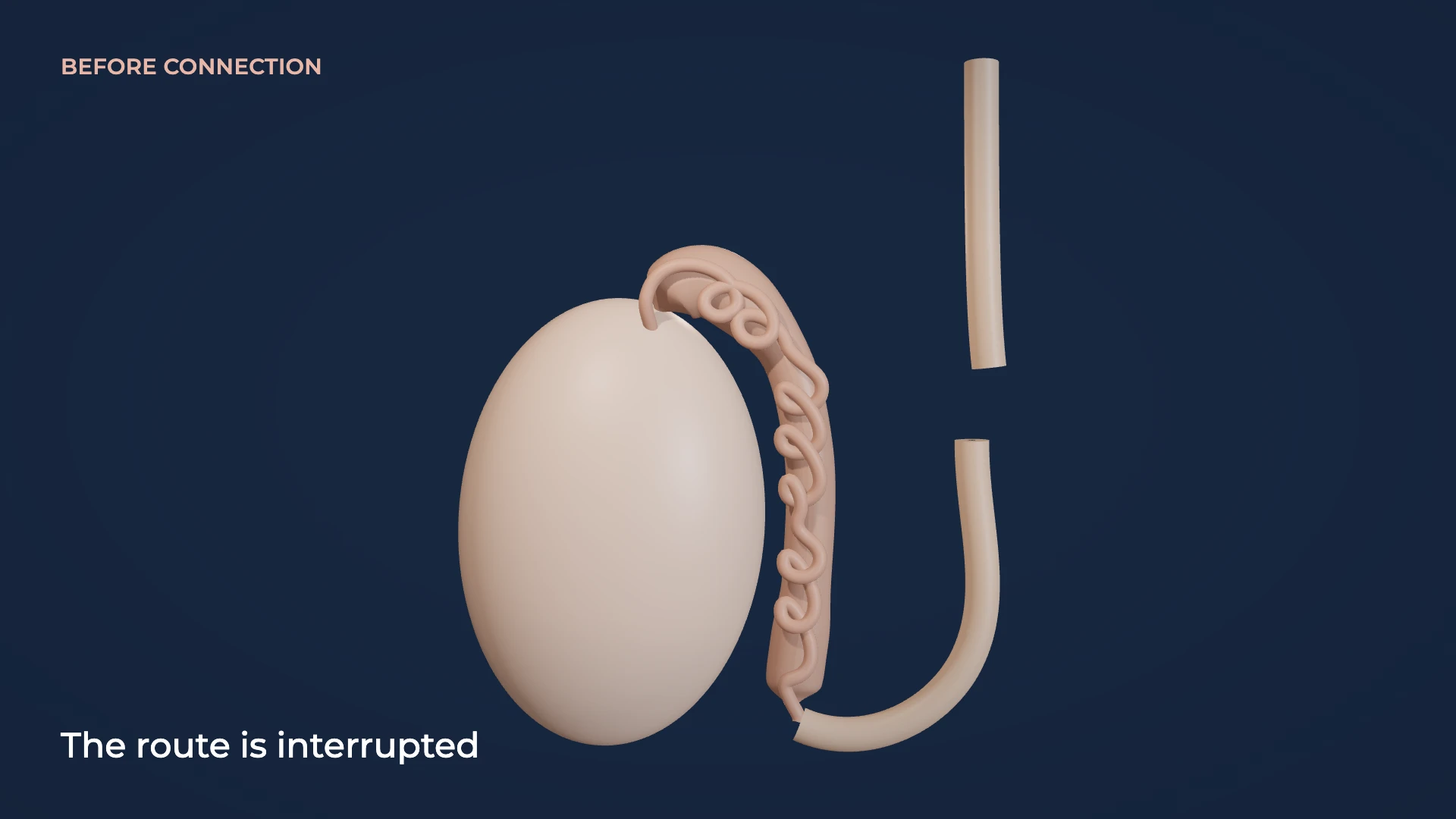
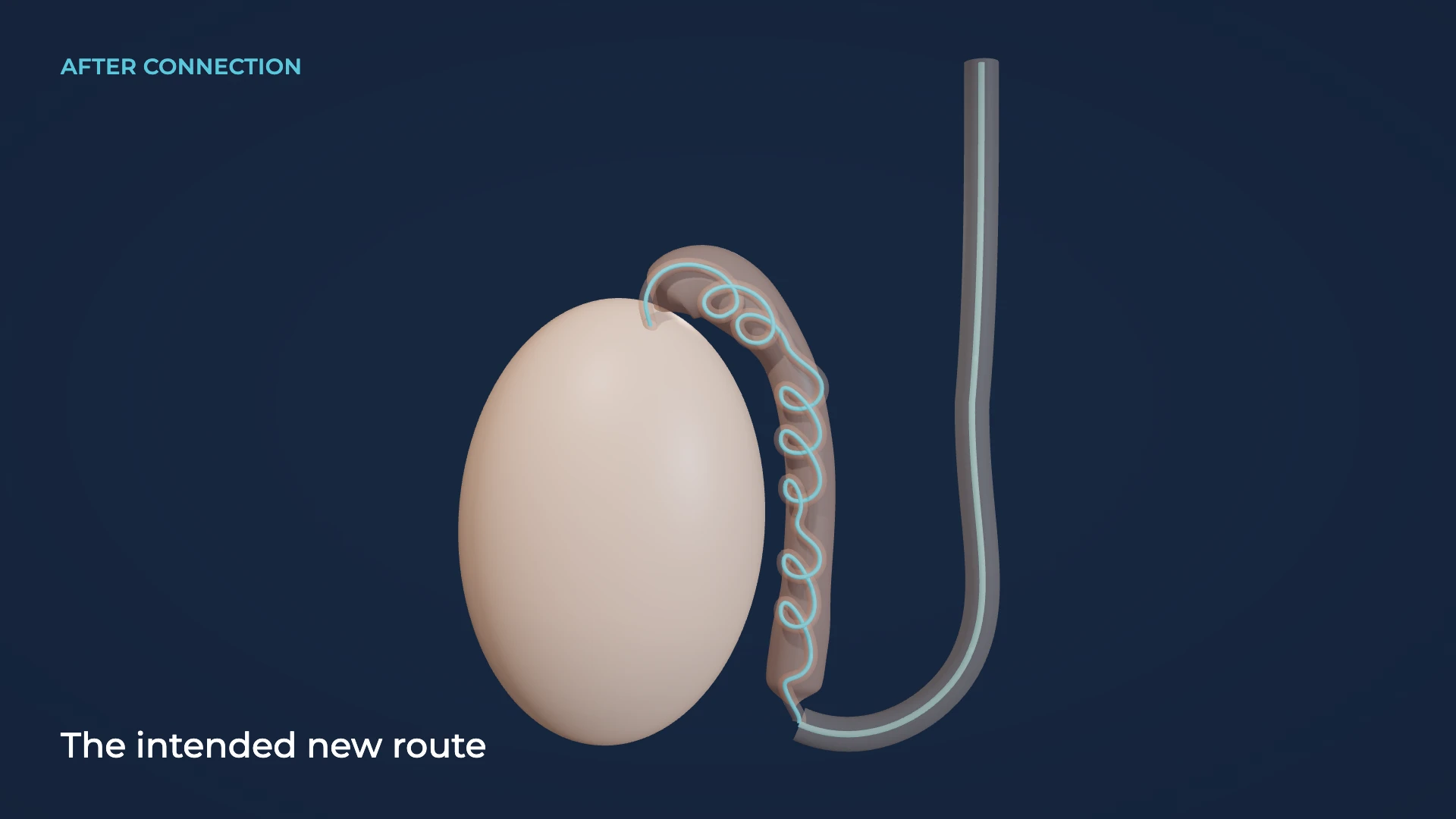
The cyan line shows the intended route. Follow-up semen tests check whether sperm have returned.
Read the explanation
Your options
Compare the paths for your situation
A reversal is one of four paths. Answer a few questions to see what each path can do for couples like you, what it costs you both, and how sure the numbers are. Nothing you enter leaves this device.
Everything you might ask about a vasectomy reversal.
Answers from Dr. Flannigan’s practice at the RSM Centre, with the published studies behind every number. Checked October 2026.
Back to the animationUnderstanding reversal
What is a vasectomy reversal?
It is an operation that reconnects the vas deferens, the tube that carries sperm from the testicle, so sperm can reach the semen again. It is done with a high-powered operating microscope.
There are two kinds of connection. Most often the two cut ends of the vas are joined (a vas-to-vas repair, or vasovasostomy). Sometimes there is a second blockage further up, in the coiled tube behind the testicle called the epididymis. Then the vas is joined to a tiny epididymal tubule above that blockage (a bypass, or vasoepididymostomy).
Sources: Flannigan Fertility, FAQ
Link to this answerIs it common to have a vasectomy reversed?
Yes. Dr. Flannigan’s clinic estimates that about 5 to 10 in 100 men who have a vasectomy will seek a reversal at some point in their lives.
Sources: Flannigan Fertility, FAQ
Link to this answerWhat technique does the RSM Centre use?
For a vas-to-vas repair, Dr. Flannigan uses a method called multi-layer microdot. Before stitching, tiny dots are marked on the cut ends of the tube to plan exactly where each stitch will go, and the tube is then joined in layers. His change to the method is extra “hitch” stitches that take tension off the join. The inner layer uses 10-0 stitches, which are finer than a hair on your head (a hair is 70 to 100 microns across, and a micron is one thousandth of a millimetre). The outer layers use 9-0 stitches. The animation shows this repair with six inner lining stitches and twelve outer supporting stitches.
For a bypass, he uses a method called LIVE, also with 10-0 and 9-0 stitches under the microscope.
Sources: Flannigan Fertility, FAQ, Alhamam 2025 (RSM Centre series)
Link to this answerHow is the type of connection chosen? Can you tell before surgery?
It cannot be known for sure before surgery. During the operation, the surgeon looks at fluid from the testicle end of the vas under a microscope.
- If there are sperm or sperm parts, the tube above is likely open, and a vas-to-vas repair can be done. In the RSM Centre’s 2025 report, the team needed to see at least sperm heads with short tails before doing a vas-to-vas repair.
- If there are none, there is probably a second blockage in the epididymis. The surgeon then searches up the epididymis until sperm are found and makes the bypass above the blockage.
Each side is checked on its own, so one side may get a vas-to-vas repair and the other a bypass. In the RSM Centre’s published series, about 1 in 4 men (35 of 136) needed a bypass on at least one side, and the chance rises with the years since the vasectomy.
Sources: Flannigan Fertility, FAQ, Flannigan Fertility, reversal page, CUA guideline 2023, Alhamam 2025 (RSM Centre series), AUA/ASRM guideline 2024
Link to this answerDoes the time since my vasectomy matter?
Yes. The longer it has been since the vasectomy, the more likely a second blockage is, so a bypass is needed more often. At the RSM Centre, the type of connection needed changed like this:
| Years | Vas-to-vas both sides | One of each | Bypass both sides |
|---|---|---|---|
| 0 to 5 | 85% | 9% | 6% |
| 6 to 10 | 74% | 18.5% | 7.5% |
| 11 to 15 | 72% | 23% | 5% |
| 16 to 20 | 27.3% | 27.2% | 45.5% |
| 21 to 26 | 50% | 33% | 17% |
The clinic has not published how many men were in each group, and the longer groups do not follow a smooth pattern (a bypass on both sides in 45.5% at 16 to 20 years but 17% at 21 to 26 years), so treat those figures with care. In Dr. Flannigan’s experience, the success of each type of connection does not change with time; what changes is how often a bypass is needed. He has done successful reversals from under a year to 26 years after a vasectomy. The RSM Centre’s 2025 study does not give success rates by years since vasectomy.
Other centres have found that success drops somewhat with time, even for vas-to-vas repairs alone. A review that pooled 31 studies of vas-to-vas repairs (6,633 men) found sperm return was more likely when the vasectomy was under 10 years ago than when it was 10 years or more. Some other studies found no clear change with time, so experts do not fully agree.
In an older study published in 1991, 1,247 men had a first reversal at five centres. Among the men who had a semen test afterwards, sperm returned in 97% when the vasectomy was less than 3 years before, 88% at 3 to 8 years, 79% at 9 to 14 years and 71% at 15 years or more. Among couples whose pregnancy results were known, pregnancy followed in 76%, 53%, 44% and 30%. That study did not report vas-to-vas and bypass repairs separately, so part of this drop may come from more men needing a bypass.
Sources: Alhamam 2025 (RSM Centre series), Flannigan Fertility, reversal page, Flannigan Fertility, FAQ, Herrel 2015 (review), Boorjian 2004, Belker 1991 (Vasovasostomy Study Group)
Link to this answerWhat if there is a big gap in my vas from the vasectomy?
In nearly all cases the ends can still be joined. Rarely, a very large gap makes it hard to join the tube without tension, which matters for success.
Sources: Flannigan Fertility, FAQ
Link to this answerWhat is the keyhole approach?
It is a way to do the vas-to-vas repair through one small puncture in the skin of the scrotum, using the same methods as a no-scalpel vasectomy. Over the years the cuts used for this surgery have become smaller, and this is the newest step. The RSM Centre team published it in 2026. The published summary describes how it is done, not its success rates. Your surgeon will tell you whether it suits you.
Sources: Brink 2026 (RSM Centre)
Link to this answerCan a reversal help long-lasting pain after a vasectomy?
Sometimes. A small number of men have pain that lasts after a vasectomy. A reversal is one option, usually offered after treatment with medicines has not helped.
In two small studies, most men had less pain. In one, 13 of 14 had less pain after surgery and half were pain-free, but the pain later came back to its starting level in 2 men, so 11 of 14 had lasting benefit. Only 13 men answered that study’s survey, so its numbers are rough. In the other study, 9 of 13 men were pain-free. These studies are small, so ask your surgeon how this applies to you.
Sources: Horovitz 2012, Nangia 2000
Link to this answerBefore surgery
When is the best time to have a reversal?
Plan it for when you are ready to start trying for a pregnancy, ideally within about a year of when you want children. Sperm usually take a few months to come back. In published studies, when a repair narrows again later (late failure), it happened on average about 6 to 14 months after surgery. Having the reversal close to when you plan to try gives you the best chance of conceiving while counts are good, rather than having surgery years ahead.
If you are not ready yet, talk with your surgeon about timing and about freezing sperm.
Sources: Farber 2019 (review)
Link to this answerDo I need any tests before booking?
Most healthy men need no blood work or tests before booking. Blood tests for hormones are needed if you have used testosterone or gym anabolic steroids, and may be done if it has been more than 10 years since your vasectomy. If you want sperm frozen during the reversal, extra blood work is needed before surgery, so tell the clinic early.
Sources: Flannigan Fertility, FAQ
Link to this answerCan I have a reversal if I take testosterone?
Yes, but not while you are taking it or within three months of stopping. Testosterone lowers your testicles’ ability to make their own testosterone and sperm. Your own sperm production should be active at the time of surgery, because the surgeon looks for sperm in the fluid to help choose the right connection.
There are two ways forward: stop testosterone and have Dr. Flannigan check your blood until the hormones that drive sperm production are back to normal, for at least three months; or stop it and start hormone medicines, such as hCG injections, clomiphene, or both, to help your testicles start making their own testosterone again. Both medicines are used off-label for this, which means in a way that is not listed on the drug’s official label.
Sources: Flannigan Fertility, FAQ
Link to this answerShould my partner have a fertility check?
It can always be considered. Dr. Flannigan asks screening questions about your partner’s health and reproductive history. If your female partner is 35 or older, a fertility assessment at one of the fertility centres he works with is usually recommended. This typically means a history, an exam, blood tests and sometimes an X-ray test to check the fallopian tubes.
Sources: Flannigan Fertility, FAQ
Link to this answerDoes my partner’s age matter?
Yes. Guidelines say a woman’s age is the most important factor in any couple’s chance of getting pregnant. In one reversal study of 294 couples, pregnancy followed in 56% when the female partner was 39 or younger and 14% when she was 40 or older. Dr. Flannigan’s clinic FAQ quotes higher figures from another study: 78% when the woman is 30 to 39 and about 42% when she is 40 to 44. Not every reversal study has found such a clear effect, and the numbers differ from study to study.
Sources: Gerrard 2007, Flannigan Fertility, FAQ, AUA/ASRM guideline 2024
Link to this answerDoes my own age matter?
Less than your partner’s. In a study of over 3,000 men, pregnancy followed in 33.4% of couples when the man was under 50 and 26.1% when he was 50 or older. But once the researchers allowed for other differences, such as the partner’s age and how long ago the vasectomy was done, being 50 or older did not on its own make a clear difference to the chance of pregnancy. Men 50 or older more often needed a bypass (19.5% compared with 10.1%); their vasectomies had also been done longer ago on average (17.6 compared with 8.9 years).
Sources: Nusbaum 2020
Link to this answerDoes it matter if I have a new partner?
It can. In a Quebec study of 605 vas-to-vas reversals, pregnancy followed in 45% of couples who were together before the vasectomy and in 30.7% of couples with a new partner. The study does not settle why, and many couples with a new partner do conceive. Ask your surgeon how this applies to you.
Sources: Bolduc 2007 (Quebec)
Link to this answerCan sperm be frozen during the reversal?
Yes. During the reversal a small sample of tissue, about the size of a pencil eraser head, can be taken and sent to an IVF centre to be frozen as a backup. This must be arranged before surgery, because it needs extra blood work. Dr. Flannigan’s clinic lists the added cost as $1,700 to $2,500. The fertility centre that stores the frozen sperm also charges its own storage fees, often yearly, so ask them for a quote.
Guidelines suggest offering it especially when a bypass is needed. No one can know for sure before surgery whether you will need one, and freezing has to be set up ahead of time, so decide about it at your consultation. It is especially worth asking about if your vasectomy was many years ago, because the chance of needing a bypass goes up with time.
Sources: Flannigan Fertility, FAQ, CUA guideline 2023, EAU guideline 2026
Link to this answerCan a reversal cause erection problems?
No. A reversal works on the sperm tubes, not on the structures that create erections.
Sources: Flannigan Fertility, FAQ
Link to this answerThe day of surgery
What anesthetic will I have?
Dr. Flannigan usually does reversals under a general anesthetic at a surgical centre, so you are asleep for the operation. He also leaves local freezing in the area, which lasts about 4 to 6 hours.
Sources: Flannigan Fertility, FAQ
Link to this answerHow long does the operation take, and can I go home the same day?
Dr. Flannigan usually takes 2 to 3 hours for the operation; times at other centres vary. It is day surgery: in nearly all cases you go home the same day.
Sources: Flannigan Fertility, FAQ
Link to this answerDo I need someone with me?
Yes. Bring someone with you to surgery, and have someone with you for the first 24 hours afterwards.
Sources: Flannigan Fertility, FAQ
Link to this answerRecovery
Is it painful, and what should I take?
Most men do well. Expect some mild sharp or aching pain at the cuts and in the testicles. Unless a doctor has told you not to take them, start with acetaminophen (Tylenol), following the label, for the first 24 to 72 hours, and add ibuprofen if you need more relief; the two can be taken together.
Dr. Flannigan often gives a prescription at the time of surgery for Tylenol #3 (Tylenol with codeine) or Tramacet (Tylenol with tramadol). Fill it only if regular Tylenol and ibuprofen are not working well enough. Both already contain acetaminophen, so take them instead of regular Tylenol, never with it. They can still be combined with ibuprofen. Codeine and tramadol are stronger prescription pain medicines, so ask your pharmacist how to take them safely.
Sources: Flannigan Fertility, FAQ
Link to this answerWhat will the wound look like?
You will have a gauze wrap around the scrotum for support, with a square dressing over each cut. Some blood spotting is normal. You can take the dressing off after two days if it is still on; it is fine if the wrap falls off sooner. Then wear snug, supportive underwear that keeps the testicles lifted. A pad in your underwear can catch any spotting. Some bruising, swelling and a small scab are common.
Sources: Flannigan Fertility, FAQ
Link to this answerWhen can I shower, bathe or swim?
Wait 48 hours before showering. For the first week after that, do not let the shower spray hit the cuts directly, until the skin edges have sealed. Wait 2 to 3 weeks before baths, pools, lakes or the ocean, to lower the risk of infection. Even after that, stay out of hot tubs and saunas and avoid long hot baths in the months before and while you try for a pregnancy, because heat can lower sperm quality.
Sources: Flannigan Fertility, FAQ
Link to this answerDo the stitches dissolve?
Yes. There are stitches on both sides of the scrotum, and they usually fall out within 4 to 6 weeks. After three weeks you can gently pull at the ends; when they are ready, they will come out.
Sources: Flannigan Fertility, FAQ
Link to this answerWhen can I go back to work?
- Working from home: about one week.
- Office work: one to two weeks.
- Physical work: 2 to 3 weeks.
Sources: Flannigan Fertility, FAQ
Link to this answerWhen can I exercise or have sex?
- Walking around home: later the same day.
- Lifting small things around the house: after a few days.
- Long walks: after 10 to 14 days.
- Weight training: around three weeks.
- Cycling: about one month.
- Sex or ejaculation: after four weeks.
- Moderate to hard exercise: 4 to 6 weeks.
Keep the testicles well supported while the joins heal, so there is no pull on them.
Sources: Flannigan Fertility, FAQ
Link to this answerWhat are the risks?
Most men recover well. Some swelling, bruising and discomfort are common. Dr. Flannigan’s clinic quotes these risks:
- Bleeding that causes significant swelling of the scrotum (a hematoma): less than 5 in 100.
- Infection: about 1 to 3 in 100.
- Less common: injury to the spermatic cord (the bundle that runs up from the testicle and holds the vas and the testicle’s blood vessels), the epididymis or the testicle, or pain that lasts.
The repair can also fail to work, or close off later. See “Results and pregnancy” below.
Sources: Flannigan Fertility, FAQ
Link to this answerWhen should I call the team or go to emergency?
- Contact the team right away if the scrotum swells beyond the size of an orange or grapefruit.
- Go to emergency if the swelling keeps changing over the day. Tell the doctor there that Dr. Flannigan did your surgery and can be contacted.
- Contact the team or your own doctor if pain gets worse 1 to 2 weeks after surgery, the cuts become red, or you have a fever or chills. These can be signs of infection.
- Contact the team about any other symptom that worries you. The clinic’s phone number and contact form are under How can I see Dr. Flannigan?
Sources: Flannigan Fertility, FAQ
Link to this answerI live outside Vancouver. What should I plan?
- If you live more than a couple of hours away, arrive the day before surgery.
- Stay in the area for a day or two afterwards in case any problem comes up.
- Flying home is fine, but move around regularly to lower the risk of blood clots, and do not lift heavy luggage.
- You do not need to travel back to Vancouver for follow-up. Semen tests can be done at your local lab, and the team reviews the results with you by telehealth. If there is a problem from the surgery, the team can arrange an office visit or help you get care from your local medical team.
Sources: Flannigan Fertility, FAQ
Link to this answerResults and pregnancy
What results does the RSM Centre report?
In the RSM Centre’s published series of microsurgical reversals:
| Repair | Men counted | Any sperm | 2 million or more moving sperm |
|---|---|---|---|
| All reversals | 136 | 97.7% | 93.1% |
| Vas-to-vas both sides | 101 | 99% | 95.5% |
| One of each | 23 | 100% | 88.8% |
| Bypass both sides | 12 | 83% | around 70% |
Of the 159 men who had surgery, 23 were lost to follow-up and are not counted. The other 136 had a semen test within six months of surgery and at least six months of follow-up. The study does not say how many men the moving-sperm column is based on, so those figures may come from fewer men. The one-of-each and bypass groups are small (23 and 12 men), so their figures are less certain.
These figures show whether sperm came back, not whether a pregnancy followed. They are results from other men, not a prediction for you.
Sources: Alhamam 2025 (RSM Centre series), Flannigan Fertility, reversal page
Link to this answerWhat is the chance of pregnancy?
Pregnancy depends on the reversal working and on the fertility of both partners, especially the female partner’s age. It is lower than the chance of sperm coming back.
In an older Quebec study of first vas-to-vas reversals done by one surgeon between 1984 and 2000, 33.4% of couples had a natural pregnancy leading to a birth within one year, and 52.9% within two years. Only men who had at least one semen test after surgery were counted. Couples who did get pregnant took 10.7 months on average, ranging from 1 to 36 months (that average also includes men who had a repeat reversal). Among couples who do conceive, Dr. Flannigan’s clinic says most do so within the first year and a half.
Sources: Bolduc 2007 (Quebec), Flannigan Fertility, FAQ, Gerrard 2007
Link to this answerWhen can we start trying?
You can start once you are allowed to ejaculate again, after four weeks. It is possible to conceive soon after surgery, but for most men it takes several months for the number of moving sperm to reach the normal range, and most couples conceive within the first 1.5 years after surgery.
Sources: Flannigan Fertility, FAQ
Link to this answerWhen are my semen tests?
Your first semen test is about six weeks after surgery, at a local lab such as LifeLabs, with a requisition from the team. If you had a bypass on both sides, it is usually about eight weeks. Tests are repeated, often every 2 to 3 months, until counts are normal or your partner is pregnant.
Sources: Flannigan Fertility, FAQ, Alhamam 2025 (RSM Centre series)
Link to this answerHow long until sperm come back?
After a vas-to-vas repair, sperm usually appear within a few months: the average in published studies ranges from 1.7 to 4.3 months. After a bypass it takes longer, on average 2.8 to 6.6 months, and the European guideline notes it can take 3 to 18 months. The review behind these averages was not limited to men who had a vasectomy, so treat them as a rough guide. Counts often keep rising for several months after sperm first appear.
Sources: Farber 2019 (review), EAU guideline 2026, Flannigan Fertility, FAQ
Link to this answerHow can we improve our chances?
- Time sex with ovulation. Ovulation apps or kits from the pharmacy can help. Sex every day or every other day in the days before and at ovulation is fine.
- Keep the testicles well supported while the joins heal.
- Avoid heat: hot tubs, saunas, steam rooms and long hot baths can lower sperm quality in the months before trying.
- Avoid recreational drugs, and keep alcohol to fewer than five drinks a week.
- Do not smoke. In one large study, men who had smoked had a lower chance of pregnancy after a reversal, though other studies found no difference.
Sources: Flannigan Fertility, FAQ, Nusbaum 2020
Link to this answerAre sperm healthy after a reversal?
Yes, they are believed to be healthy and able to start a pregnancy. The number of moving sperm matters most for natural pregnancy.
Sources: Flannigan Fertility, FAQ
Link to this answerWhat about antisperm antibodies?
Antibodies against sperm are common after a reversal. In one study, 58% of men had high levels. Only 67 men in that study answered a follow-up phone call; among them, pregnancy rates were about the same with high or low levels (75% and 70%). Not every study agrees: the authors of a Quebec study concluded that antibodies in semen lowered the chance of pregnancy. So the effect is not settled.
The American guideline on male infertility advises testing only if the result would change your plan. If IVF with ICSI is used, the antibodies do not matter, because the sperm is injected straight into the egg.
Sources: Nam 2024, Bolduc 2007 (Quebec), AUA/ASRM guideline 2024
Link to this answerCan the tube close off again later?
Yes, sometimes. Sperm can return and then fall to zero or very low numbers months later. Dr. Flannigan’s clinic quotes the chance of this late failure at about 5 to 15%. In a review of published studies this happened after 0 to 12% of vas-to-vas repairs and 1 to 50% of bypasses. When it happens, the average time in different studies ranged from 9.7 to 13.6 months after a vas-to-vas repair and from 6 to 14.2 months after a bypass.
In one study, newer bypass methods like the one used at the RSM Centre had fewer late failures than older ones (4% compared with 37%). But men who had the newer methods were followed for a shorter time, and late failures can take time to show up, so the real gap may be smaller.
This is one reason to time the reversal close to when you plan to start trying, and why some couples freeze sperm once it has returned, especially after a bypass. Ask your surgeon whether this makes sense for you.
Sources: Flannigan Fertility, FAQ, Farber 2019 (review), Schiff 2005, CUA guideline 2023
Link to this answerWhat if the reversal does not work?
There are still options:
- A repeat reversal. In a large older study, published in 1991, sperm returned in 75% of men after a repeat operation, and 43% of couples had a pregnancy; that study did not give separate results for each type of connection. In a smaller study, results were lower when the second operation could only be a bypass: sperm returned in 47% of men and 15% of couples had a pregnancy, compared with 93% and 43% when at least one side could be joined vas to vas.
- Sperm retrieval in the office with a needle (PESA) or a small biopsy (TESE), then IVF with ICSI.
- Frozen sperm, if some was stored.
- Donor sperm or adoption.
Sources: Flannigan Fertility, FAQ, Belker 1991 (Vasovasostomy Study Group), Matthews 1997
Link to this answerReversal or IVF
What are all my options for having a child after a vasectomy?
Using your own sperm, there are three:
- Vasectomy reversal, then trying for pregnancy naturally.
- Reversal with sperm freezing during the same operation, as a backup.
- Sperm retrieval with IVF, skipping the reversal.
Options without your sperm are donor sperm and adoption. Both reversal and IVF can work well; the right choice depends on your partner’s age and fertility, how many children you hope for, timing and cost. If there are fertility problems on the female side, IVF may be the better choice.
Sources: Flannigan Fertility, reversal page, Witherspoon and Flannigan 2021
Link to this answerWhat is sperm retrieval with IVF?
Sperm are taken directly from the epididymis with a needle (PESA) or from the testicle with a small biopsy (TESE). This is done in the office under local freezing, much like a dental visit, and the sperm are frozen at the IVF centre. Dr. Flannigan’s clinic lists the cost as about $2,500. If you think you might want a reversal later, tell your surgeon before any sperm retrieval: a needle into the epididymis can scar and block it, so the American guideline advises against taking sperm from the epididymis when a reversal might be done later.
Your partner then has hormone treatment and an egg collection, and each egg is injected with a single sperm (ICSI). In one study of 59 men after vasectomy, a needle into the epididymis or the testicle found sperm in about 97 in 100 men, though about 3 in 10 needed the needle in the testicle. In another study of 66 men, a needle into the epididymis alone found sperm in fewer than 1 in 3, but when a small testicular biopsy was used as a backup, sperm were found in every man. Both studies were small.
Sources: Flannigan Fertility, FAQ, Esteves 2013, Wood 2002, AUA/ASRM guideline 2024
Link to this answerHow do reversal and IVF compare?
| Reversal | Sperm retrieval with IVF | |
|---|---|---|
| Procedures | One day surgery for you. | An office procedure for you; hormone injections and an egg collection for your partner. |
| Trying for a baby | At home, every month, and for more than one child, once sperm return. | Each attempt is a treatment cycle. Frozen embryos can allow later transfers. |
| Chance of a baby | Similar in the only study we found that compared them directly, at one clinic in Belgium: of 99 couples who started with a reversal, 49.5% had a baby, counting those who later moved on to IVF; of 64 couples who went straight to IVF, 43.8% had a baby. | |
| Time to pregnancy | Longer: 16 months on average, for couples who conceived. | Shorter: 8 months on average. |
| Risks to your partner | None from the surgery. | Egg collection complications in about 4 per 1,000 collections; the ovaries overreacting to the hormone injections (ovarian hyperstimulation); twins or more in 3.4% of Canadian IVF births in 2024. |
| Cost in BC | About $10,000 at Flannigan Fertility; not covered by MSP. | About $21,000 to $27,000 for one cycle with sperm retrieval and drugs, before public funding (our estimate from 2026 clinic price lists; clinics may bundle fees differently, so ask for a written quote). |
Dr. Flannigan’s clinic says that for otherwise healthy couples hoping for one or more children, reversal is usually the most cost-effective choice. IVF may suit couples who need a pregnancy sooner or have fertility problems on the female side.
Sources: Uvin 2018 (Brussels), Levi-Setti 2018, CARTR Plus 2026 (Canada), Flannigan Fertility, reversal page, Flannigan Fertility, FAQ, Olive Fertility price list, PCRM price list
Link to this answerWhat are the chances with IVF?
It depends mostly on the female partner’s age. In Canada, out of every 100 egg collections using the woman’s own eggs, about 46 led to a birth when she was under 35, 33 at 35 to 37, 20 at 38 to 40, 9 at 41 to 42 and 3 at 43 or older. These counts include any embryo transferred from that collection in the next 12 months, without genetic testing of the embryos. These figures are for IVF for any reason, not only after vasectomy.
Sources: CARTR Plus 2026 (Canada)
Link to this answerDoes BC pay for IVF?
BC’s publicly funded IVF program can pay up to $19,000 toward one IVF cycle. The person who will have the embryo transfer must be 41 or younger when you apply. All intended parents must be enrolled in MSP when you apply and stay enrolled for at least nine months after approval. The amount depends on household income: the full amount at $100,000 or less, stepping down to nothing above $250,000. A past vasectomy does not affect eligibility, and ICSI is covered. Funding is limited each year. Ask the IVF clinic whether the sperm retrieval itself is covered.
Sources: BC publicly funded IVF program
Link to this answerCost and booking
How much does a reversal cost?
At Flannigan Fertility, as listed in October 2026:
- Consultation: $195.
- Reversal surgery: $9,995, including surgical centre fees.
- Follow-up visits after surgery: no charge.
- Optional sperm freezing at the same operation: $1,700 to $2,500, plus storage fees charged separately by the fertility centre that keeps it.
Across Canada, Dr. Flannigan’s clinic wrote in May 2025 that a reversal costs between $7,400 and $15,000, depending on the site and surgeon. Some clinics list less: one Ontario clinic lists $5,500, but its page has no date and covers only a vas-to-vas repair. The clinic’s page lists financing through Beautifi, a third-party lender. Check with the clinic for current fees, and ask whether the price still applies if you need a bypass.
Sources: Flannigan Fertility, reversal page, Flannigan Fertility, FAQ, Flannigan Fertility, cost in Canada, Sarnia Urology fee page
Link to this answerDoes MSP cover a reversal?
No. In BC, MSP does not pay for a reversal after a vasectomy, whatever the reason, including pain. The BC payment schedule pays for this operation only when a man has not had a vasectomy. MSP also does not pay for the consultation or follow-up care for private surgery like this, but Dr. Flannigan’s clinic does not charge for follow-up visits.
Sources: Flannigan Fertility, FAQ, BC MSC Payment Schedule 2026
Link to this answerDo I need a consultation first?
Yes. At the consultation Dr. Flannigan takes a full fertility and medical history and goes over the operation, the other options, the expected results and the risks, so you and your partner can decide together. It is also your chance to ask questions.
Sources: Flannigan Fertility, FAQ
Link to this answerHow can I see Dr. Flannigan?
Dr. Flannigan sees patients for microsurgical vasectomy reversal through Flannigan Fertility at 2775 Laurel Street, Vancouver. You can refer yourself for a reversal: use the contact form on the clinic’s website to ask for a consultation, or call 604-875-5683. The clinic aims to offer a consultation within 1 to 2 weeks. At the consultation, it looks to book your surgery if it is the right fit for you and your partner. Surgery is usually about 1 to 3 months after the consultation.
Services are for Canadian citizens and residents only.
Sources: Flannigan Fertility, reversal page, Flannigan Fertility, FAQ
Link to this answerNo questions match. Try another word, or see how to reach the clinic.
Questions to bring
Tick the ones that matter to you and print the list, or show it on your phone at the visit.
Sources for this guide (42)
Clinic details come from Flannigan Fertility’s own pages. Every number comes from the study or page listed with it; the RSM Centre figures are from its published series. Prices are as listed in October 2026 and may change.
- Flannigan Fertility. Frequently asked questions (read October 12, 2026). Open (opens in a new tab)
- Alhamam A, Liblik K, Witherspoon L, et al. Techniques in urology: Tension-relieving microdot vasovasostomies and longitudinal intussuscepted vasoepididymostomy vasectomy reversals: A first report. Can Urol Assoc J 2025;19(3):E114-8. Open (opens in a new tab)
- Flannigan Fertility. Vasectomy reversal (read October 12, 2026). Open (opens in a new tab)
- Flannigan R, Tadayon Najafabadi B, Violette PD, et al. 2023 Canadian Urological Association guideline: Evaluation and management of azoospermia. Can Urol Assoc J 2023;17(8):228-40. Open (opens in a new tab)
- Brannigan RE, Hermanson L, Kaczmarek J, et al. Updates to Male Infertility: AUA/ASRM Guideline (2024). J Urol 2024;212(6):789-99. Open (opens in a new tab)
- Herrel LA, et al. Urology 2015;85(4):819-25 (meta-analysis of 31 studies of microsurgical vasovasostomy). Open (opens in a new tab)
- Boorjian S, Lipkin M, Goldstein M. The impact of obstructive interval and sperm granuloma on outcome of vasectomy reversal. J Urol 2004;171(1):304-6. Open (opens in a new tab)
- Belker AM, Thomas AJ, Fuchs EF, et al. Results of 1,469 microsurgical vasectomy reversals by the Vasovasostomy Study Group. J Urol 1991;145(3):505-11. Open (opens in a new tab)
- Brink SM, et al. Techniques: Single keyhole puncture microsurgical vasovasostomy. Can Urol Assoc J 2026;20(9):E365-7. Open (opens in a new tab)
- Horovitz D, et al. J Urol 2012;187(2):613-7 (vasectomy reversal for pain after vasectomy). Open (opens in a new tab)
- Nangia AK, et al. J Urol 2000;164(6):1939-42 (vasectomy reversal for pain after vasectomy). Open (opens in a new tab)
- Farber NJ, Flannigan R, Li P, et al. The kinetics of sperm return and late failure following vasovasostomy or vasoepididymostomy: a systematic review. J Urol 2019;201(2):241-50. Open (opens in a new tab)
- Gerrard ER, Sandlow JI, Oster RA, et al. Effect of female partner age on pregnancy rates after vasectomy reversal. Fertil Steril 2007;87(6):1340-4. Open (opens in a new tab)
- Nusbaum, et al. Urology 2020;145:134-40 (reversal outcomes in men 50 or older compared with younger men). Open (opens in a new tab)
- Bolduc S, Fischer MA, Deceuninck G, et al. Factors predicting overall success: a review of 747 microsurgical vasovasostomies. Can Urol Assoc J 2007;1(4):388-94. Open (opens in a new tab)
- European Association of Urology. Guidelines on Sexual and Reproductive Health, limited update March 2026 (male infertility, obstructive azoospermia). Open (opens in a new tab)
- Nam CS, et al. Urology 2024;186:154-61 (antisperm antibodies and pregnancy after vasectomy reversal). Open (opens in a new tab)
- Schiff J, Chan P, Li PS, et al. Outcome and late failures compared in 4 techniques of microsurgical vasoepididymostomy in 153 consecutive men. J Urol 2005;174(2):651-5. Open (opens in a new tab)
- Matthews GJ, et al. J Urol 1997;157(3):844-6 (repeat reconstruction after failed vasectomy reversal). Open (opens in a new tab)
- Witherspoon L, Flannigan R. Fertility treatment options after vasectomy. BCMJ 2021;63(2):62-6. Open (opens in a new tab)
- Esteves SC, Lee W, Benjamin DJ, et al. Reproductive potential of men with obstructive azoospermia undergoing percutaneous sperm retrieval and intracytoplasmic sperm injection according to the cause of obstruction. J Urol 2013;189(1):232-7. Open (opens in a new tab)
- Wood S, Vang E, Troup S, et al. Surgical sperm retrieval after previous vasectomy and failed reversal: clinical implications for in vitro fertilization. BJU Int 2002;90(3):277-81. Open (opens in a new tab)
- Uvin V, De Brucker S, De Brucker M, et al. Pregnancy after vasectomy: surgical reversal or assisted reproduction? Hum Reprod 2018;33(7):1218-27. Open (opens in a new tab)
- Levi-Setti PE, Cirillo F, Scolaro V, et al. Appraisal of clinical complications after 23,827 oocyte retrievals in a large assisted reproductive technology program. Fertil Steril 2018;109(6):1038-43. Open (opens in a new tab)
- Canadian Fertility and Andrology Society. CARTR Plus Annual Report 2026: cumulative live birth per egg retrieval, own eggs, 2020 to 2023; multiple births, 2024. Open (opens in a new tab)
- Olive Fertility Centre (Vancouver). Pricing (read October 10, 2026). Open (opens in a new tab)
- Pacific Centre for Reproductive Medicine. Self-pay fees (read October 10, 2026). Open (opens in a new tab)
- Province of British Columbia. Publicly funded IVF program (page updated June 1, 2026; read October 10, 2026). Open (opens in a new tab)
- Flannigan Fertility. What does a vasectomy reversal cost in Canada? (read October 10, 2026). Open (opens in a new tab)
- Sarnia Urology. Vasovasostomy (vasectomy reversal) fee page (undated; read October 10, 2026). Open (opens in a new tab)
- Province of British Columbia. Medical Services Commission Payment Schedule, May 31, 2026 (vasectomy reversal is a benefit only without a previous vasectomy). Open (opens in a new tab)
- Schlegel PN, Clark JY, Coward RM, et al. Fertility Restoration After Vasectomy: AUA Guideline (2026) Part II. J Urol 2026;215(3):250-5. Open (opens in a new tab)
- Practice Committee of the American Society for Reproductive Medicine. Prevention of moderate and severe ovarian hyperstimulation syndrome: a guideline. Fertil Steril 2024;121:230-45. Open (opens in a new tab)
- Davis PG, Preece PD, Rees RW. Simplifying vasectomy reversal without compromising outcomes: a single-surgeon series. Transl Androl Urol 2024;13(7):1173-9. Open (opens in a new tab)
- Mui P, Perkins A, Burrows PJ, et al. The need for epididymovasostomy at vasectomy reversal plateaus in older vasectomies: a study of 1229 cases. Andrology 2014;2(1):25-9. Open (opens in a new tab)
- Fuchs EF, Burt RA. Vasectomy reversal performed 15 years or more after vasectomy: correlation of pregnancy outcome with partner age and with pregnancy results of in vitro fertilization with intracytoplasmic sperm injection. Fertil Steril 2002;77(3):516-9. Open (opens in a new tab)
- Kolettis PN, Sabanegh ES, D'amico AM, et al. Outcomes for vasectomy reversal performed after obstructive intervals of at least 10 years. Urology 2002;60(5):885-8. Open (opens in a new tab)
- Herrel L, Hsiao W. Microsurgical vasovasostomy. Asian J Androl 2013;15(1):44-8. Open (opens in a new tab)
- Hervás I, Valls L, Rivera-Egea R, et al. TESE-ICSI outcomes per couple in vasectomized males are negatively affected by time since the intervention, but not other comorbidities. Reprod Biomed Online 2021;43(4):708-17. Open (opens in a new tab)
- McLernon DJ, Harrild K, Bergh C, et al. Clinical effectiveness of elective single versus double embryo transfer: meta-analysis of individual patient data from randomised trials. BMJ 2010;341:c6945. Open (opens in a new tab)
- Linara-Demakakou E, Bodri D, Wang J, et al. Cumulative live birth rates following insemination with donor spermatozoa in single women, same-sex couples and heterosexual patients. Reprod Biomed Online 2020;41(6):1007-14. Open (opens in a new tab)
- CAN-AM Cryoservices. Donor sperm pricing (read October 10, 2026). Open (opens in a new tab)
How helpful was this guide?
We’d like to know how well the guide works for patients. We don’t ask for your name, contact details or health numbers.
Optional and anonymous. Your answers help us improve this guide (program feedback) and, once ethics approval is in place, may also be used for research.
Taking part is voluntary and will not affect your care. You can skip any question, or the whole questionnaire. Because we can’t tell which answers are yours, they can’t be removed once sent.